
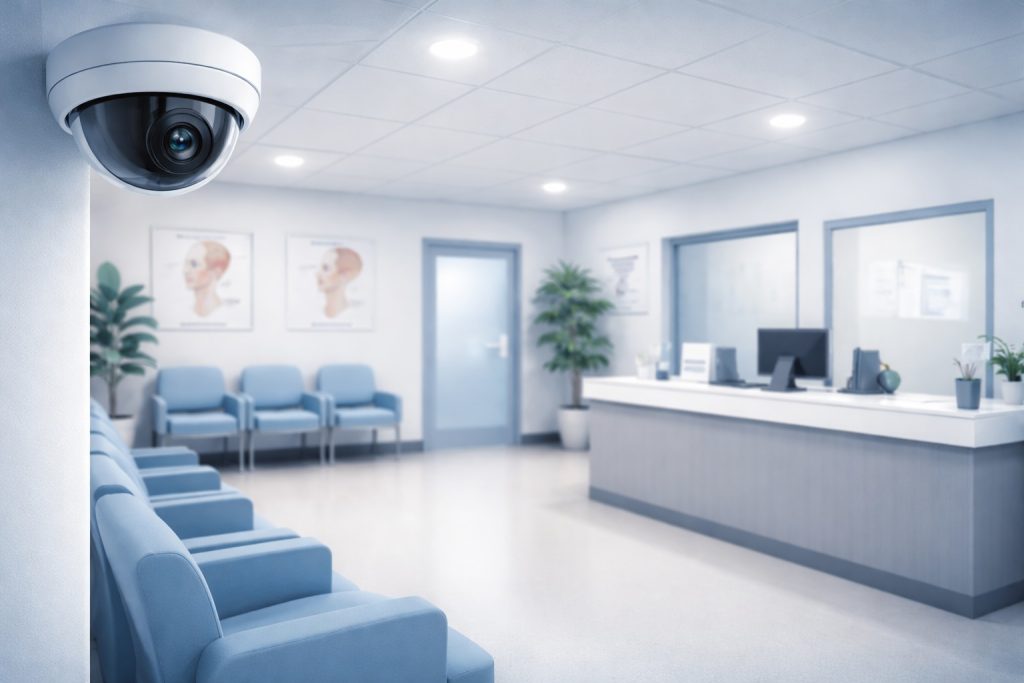
Many private practice audiology owners want a security camera in the waiting room or at the front entrance to help protect patients, staff, and property. That can make sense. But before buying a system, it is important to think about where the video is stored, who can access it, and whether the vendor is handling protected health information.
The big HIPAA issue
A camera system is not automatically “HIPAA compliant” just because it is used in a healthcare office. What matters is how the system is configured and managed.
If video footage is stored or transmitted through a cloud service, and that footage could identify someone as a patient of the practice, the vendor may be acting as a business associate. HHS says that cloud service providers that create, receive, maintain, or transmit ePHI on behalf of a covered entity generally require a HIPAA-compliant Business Associate Agreement. HHS also recognizes that some incidental disclosures can occur if reasonable safeguards are in place.
The simplest option for many small practices
For many smaller clinics, the most practical path is a local-recording camera system. These systems store footage on a recorder inside the office instead of uploading it to the vendor’s cloud by default. That usually means:
lower ongoing cost
less vendor complexity
less HIPAA contract overhead
more control over footage retention and access
- no access to the video remotely
Examples of local/on-premise options include:
What about cloud-based systems?
Some clinics want easier remote access, multi-site management, or more advanced remote monitoring. In those cases, a cloud-managed platform may be worth considering. Two vendors with public HIPAA-related materials are:
Verkada, which offers quote-based pricing and has healthcare/HIPAA contract materials available through its legal resources
Rhombus, which publicly posts a Business Associate Addendum and also posts pricing information for some configurations
These systems may be easier to manage, but they are usually more expensive and require more attention to contracts, user access, retention, and governance.
Please not that consumer cloud camera ecosystems such as Ring and Nest are designed for homes rather than healthcare. In our experience, these companies do not offer HIPAA-mandated BAAs.
What do these systems cost?
Costs vary based on the number of cameras, video quality, storage, and whether you choose local or cloud management.
Here are rough current examples:
Reolink says basic security systems may start around $100-$200, with more advanced systems in the $300-$1,000+ range.
Lorex has wired NVR systems listed from about $499.99 and up.
UniFi Protect NVR hardware is listed around $199-$299, and one current turret camera model is listed at $129.
Rhombus publicly lists some camera-and-license combinations starting around $548 total for a basic mini dome setup.
Verkada pricing is generally quote-based rather than simple retail checkout pricing.
Practical recommendations for audiology practices
For most private practices, a good starting point is:
Use cameras only in appropriate spaces such as entrances, hallways, and waiting rooms
Avoid exam rooms, treatment rooms, and other clinically sensitive areas unless there is a very specific reason and you have carefully reviewed the risks
Disable audio recording unless you have separately evaluated privacy and state-law issues
Point cameras away from sign-in sheets, schedules, intake paperwork, and staff computer screens
Keep retention limited
Restrict footage access to a very small number of authorized users
Use strong passwords and multifactor authentication where available
Prefer local storage unless your practice has a clear need for cloud management
If cloud storage or cloud access is used, confirm whether a BAA is required before deployment
- Consult with your attorney
Bottom line
For many small audiology practices, local-recording cameras are the lowest-cost and lowest-complexity option. Cloud-managed platforms may still be appropriate, but they should be chosen with eyes open: more convenience usually means more contract and compliance work.